In my Catholic testimony a few years ago, I touched only briefly on sex. I wrote that our culture has spent decades teaching that sex can be casual, separated from marriage, and separated from its most obvious consequence – a child. I also admitted that, like a lot of people, I’d mostly retreated into a “whatever floats your boat” position rather than following that logic very far.
This essay is an attempt to follow it farther. Not from Catholic doctrine, but from the act itself and the chain of consequences we’ve built around it.
On sex, contraception, and the decision most couples make before they know they’ve made it
Ask a man who is sleeping with his girlfriend what she’s using for birth control, and a surprising number can’t answer. Ask what the two of them would do if she became pregnant, and the number who can’t answer is larger still.
Both men will describe themselves as being careful.
But something has gone badly wrong with the meaning of that word. A man can be having regular sex with a woman, not know what she’s doing to prevent pregnancy, not know how effective it is, not know what she thinks about abortion, not know what he thinks about abortion, and not have had a serious conversation with her about any of it – while still regarding himself as the responsible participant because somebody, somewhere, is “on birth control.”
That isn’t primarily a problem of statistics. The statistics matter, and we’ll get to them. But beginning with failure rates makes the argument too easy to escape. It lets the obvious reply appear:
“Well, I’ll just be more careful and pick a different method.”
An implant, maybe. An IUD. Something that’s 99-point-whatever percent effective. Problem solved.
Except it isn’t. Because the problem begins before any contraceptive fails. It begins with what contraception is trying to do in the first place, and with what a couple has already decided the sexual act is supposed to mean.
What sex is for
This part doesn’t require a Bible, a church, or even particularly complicated philosophy. Aristotle was making arguments of this kind more than two thousand years ago.
Things have functions. Eyes are for seeing. Lungs are for exchanging gases. The stomach is for digestion. A heart that can’t move blood isn’t merely a heart behaving differently according to somebody’s private values. Something has gone wrong with it. To describe an organ at all is already to say something about what it does and what it’s for.
The reproductive system presents an unusually obvious case. Most bodily systems keep the individual organism alive. The reproductive system is different. Its distinctive biological function terminates in another organism.
The sex organs of a man, taken by themselves, can’t accomplish that function. Neither can those of a woman. But joined in the sexual act, they can do exactly what neither system can do alone – produce a new human organism.
That doesn’t mean reproduction is the only good connected to sex. Sex gives pleasure. It can express affection. It strengthens attachment between people. Nobody has to deny any of that.
But none of those facts removes the reproductive end. In fact the intensity of the pleasure makes considerably more sense once the reproductive function is admitted. Nature attaches an enormous reward to an act with enormous biological consequences.
And there is a difference between an act failing to achieve its natural end and deliberately acting against that end.
An infertile couple hasn’t therefore made intercourse non-reproductive in kind. An nonfunctiong eye is still an organ of sight. A digestive system that fails to absorb enough nutrients is still digestive. Failure to achieve an end isn’t the same thing as intentionally disabling the function while exercising it.
This is where contraception becomes philosophically interesting.
A condom doesn’t make sex into a different act whose natural end isn’t reproduction. Its entire design assumes what sex does and places a barrier in the path. The pill doesn’t discover that ovulation was irrelevant to sex after all. It suppresses ovulation precisely because ovulation is part of the reproductive process. An IUD doesn’t change what sperm and egg are for. It changes the conditions so that conception is less likely to occur.
Contraception only makes sense because sex remains reproductive.
The act is performed and then something is done specifically so that one of its natural powers won’t succeed. That’s what contraception is. If intercourse weren’t ordered toward reproduction, nobody would need contraception any more than people need pills to prevent themselves from becoming pregnant while shaking hands.
The modern bargain therefore isn’t really “sex without reproduction.” Biology has never offered that product.
It’s sex, plus a deliberate attempt to defeat reproduction.
And an attempt can fail.
What the failure rates actually say
The CDC’s 2014 MMWR Appendix D gives first-year pregnancy rates for contraceptive methods under both perfect use and typical use. Perfect use means the method is used consistently and correctly. Typical use is what actually happens among ordinary users.
Using the CDC’s figures consistently- these are pregnancies per 100 women during the first year:
| Method | Perfect use | Typical use |
|---|---|---|
| Implant | 0.05 pregnancies per 100 women during the first year | 0.05 pregnancies per 100 women during the first year |
| Hormonal IUD | 0.2 pregnancies per 100 women during the first year | 0.2 pregnancies per 100 women during the first year |
| Copper IUD | 0.6 etc. | 1 etc. |
| Depo-Provera | 0.2 | 6 |
| Pill | 0.3 | 9 |
| Male condom | 2 | 18 |
| Withdrawal | 4 | 22 |
| No method | 85 | 85 |
For long-acting methods such as implants and IUDs, typical use is very close to perfect use because there isn’t much for the user to remember. For user-dependent methods, the difference can be enormous. The pill goes from 0.3 pregnancies per hundred under perfect use to 9 under typical use. Male condoms go from 2 to 18. Withdrawal goes from 4 to 22.
And those are one-year figures.
If a 9 percent annual pill failure rate were treated as a constant independent probability merely to get a rough sense of scale, five years produces about a 38 percent cumulative chance of at least one pregnancy – roughly two couples in five. At 18 percent for condoms, the same arithmetic gives about 63 percent – nearly two couples in three.
Those aren’t predictions for a particular couple. Annual risks aren’t perfectly independent, fertility differs, people stop having sex, couples switch methods, and some people use methods better than others. But the arithmetic exposes the scale of what a first-year percentage hides.
More importantly, every number in the table is above zero.
“Fine. So use the implant. Five hundredths of one percent. That’s basically zero.”
No. It’s very low. That’s different.
But even if somebody invented a method tomorrow that reduced the failure rate another hundredfold, the moral problem we’re discussing would remain. The couple would still be doing the act that makes children while organizing their relationship around the premise that no child is supposed to result from it.
The better technology would make the contradiction easier to maintain. It wouldn’t remove it.
Why pregnancy feels like an ambush
This is the hinge in the whole problem.
A contracepting couple doesn’t ordinarily understand itself as a couple that might become parents tonight. The entire arrangement has been constructed so that this possibility can be psychologically set aside.
Sex is treated as the thing they chose.
Pregnancy is treated as the thing that happened to them.
That’s a very strange description of events once they’re stated plainly. No outside force introduced reproduction into intercourse. Nobody swapped the machinery while they weren’t looking. The reproductive system did what reproductive systems do.
Yet a positive pregnancy test can land like a home invasion: like: “How did this happen??” Everybody knows how it happened!
The real question is: How did the thing we had organized our lives around preventing happen anyway? That’s where contraception does something more consequential than reduce the probability of conception. It changes the category into which conception falls.
Without the contraceptive premise, pregnancy is a possible outcome of the act. The plan of a couple to “just have fun & be loving” has malfunctioned. The future that was supposed to remain available is suddenly threatened by a child who wasn’t included in it.
That child isn’t encountered first as a son or daughter. He’s encountered first as the failure of the birth control. That change in perception matters because the next decision doesn’t arrive in a vacuum.
The backstop
Contraception and abortion aren’t the same act.
Contraception tries to prevent a new organism from coming into existence. Abortion acts after one already exists. Developmental biology isn’t particularly mysterious about what fertilization does: sperm and egg fuse and initiate the development of a new organism. The zygote is the first stage of that organism’s continuous development, not a sperm or egg waiting to become one.
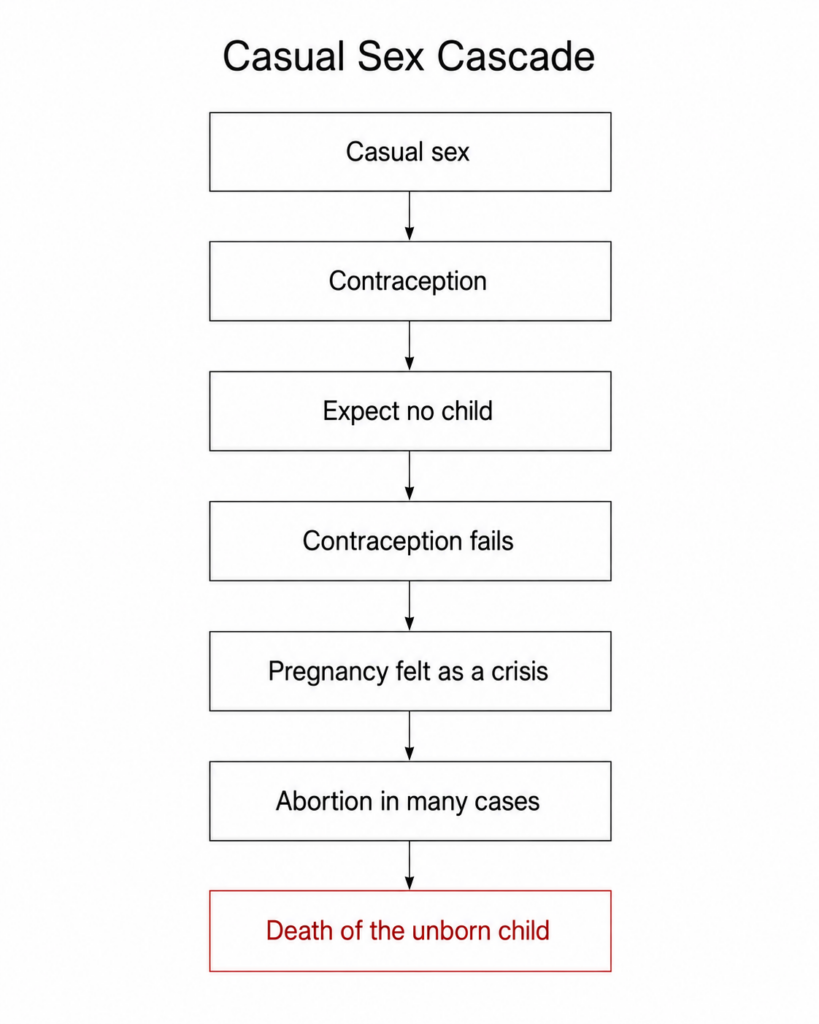
So the moral difference between contraception and abortion is real and enormous. But it doesn’t follow that there’s no structural connection between them. If the operating rule of a sexual relationship is we may have sex, but a child must not result, contraception is the first technology used to enforce the rule.
What happens when contraception fails? The rule hasn’t disappeared merely because the first technology failed. Now there’s a friggin pregnancy contradicting the arrangement. Abortion becomes the second technology capable of restoring the original plan.
That isn’t a theory invented by people opposed to abortion. The Supreme Court said it about as plainly as it could have in Planned Parenthood v. Casey. The joint opinion described abortion as an “unplanned response … to the failure of conventional birth control.” It then defended reliance on Roe partly on the ground that people had structured intimate relationships around the “availability of abortion in the event that contraception should fail.” Casey was later overruled as constitutional law by Dobbs. That doesn’t erase the factual observation the Court was making in 1992. The justices preserving the constitutional abortion right weren’t accusing anyone of hypocrisy. They were describing how the system actually worked.
It goes like this:
The Young Man Who Didn’t Decide
This all lands pretty hard on men because a man can float through the whole arrangement while transferring almost every concrete burden somewhere else: She remembers the pill, she gets the prescription, she has the device inserted, she deals with the side effects, she watches the calendar etc. etc. And if all of it fails, the pregnancy happens inside her body.
Meanwhile a man can literally not know which method is being used. Then comes the positive test. Suddenly he discovers that he has very strong feelings about what should happen next. But where the frick were those convictions the night before??
A couple that hasn’t discussed an unexpected pregnancy hasn’t postponed the decision. They’ve decided that it will be made later – under pressure, with a clock running, while both people are frightened, and with whatever beliefs happen to be strongest in the room.
A man who hasn’t even asked what his girlfriend thinks about abortion has voluntarily entered that situation blind. Maybe she thinks abortion is unthinkable? Maybe she thinks it is obvious? Maybe she has no idea? Maybe he has no idea! The point isn’t to predict her. That’s exactly what he has failed to find out!
And if he’s never stated what he believes, never asked what she believes, never established what obligations he accepts toward a child, and never made commitments proportionate to the sex act he’s performing, he shouldn’t imagine that a pregnancy will suddenly confer some moral authority he declined to exercise beforehand.
Sure – he can of course can still speak about the matter in that moment of crisis. He can still plead. He can still change his mind. But he has put himself in the worst possible position from which to do it. The decision will be compressed into days rather than considered over months or years. Whoever is most certain will have enormous practical power simply because the other person arrived morally unprepared. That isn’t an indictment of the woman. It’s an indictment of the man who helped create the pregnancy and arranged in advance to have no idea what to do about it.
What some of the birth control methods actually do
There’s another issue here, although it shouldn’t be allowed to swallow the main issue above: birth control methods can be deadly to children already.
The copper IUD’s principal action is before fertilization. Copper interferes with sperm transport and fertilization. FDA labeling for ParaGard nevertheless also lists possible prevention of implantation among its mechanisms. If such fertilization occurs “by accident”, copper can alter the reproductive tract and reduce endometrial receptivity. Blah blah – hormonal IUDs also act principally through the same types of mechanisms such as thickening cervical mucus and impairing sperm. The FDA’s Mirena labeling additionally describes alteration of the endometrium, including glandular atrophy, while noting that the exact local contraceptive mechanism hasn’t been conclusively demonstrated.
Then there is the ordinary pill. Walter Larimore and Joseph Stanford argued in a 2000 Archives of Family Medicine review that suppression of ovulation doesn’t always happen with the pill, and that the gap between breakthrough ovulation and the much lower observed pregnancy rate leaves open the possibility of secondary post-fertilization effects – in other words: the woman gets pregnant.
So here’s an analogy for you: suppose a hunter sees movement behind thick brush. He’s fairly sure it’s a deer. He’s hunted there before. Deer are common. There probably isn’t another person anywhere nearby. He still doesn’t fire until he knows what he’s shooting at. If he fires and kills a man, “I figured it was probably a deer” isn’t much of a defense. The uncertainty was the reason not to fire his gun/shoot his bow.
Where a person has a serious reason to believe that an act might end an already-begun human life, the burden isn’t satisfied by saying nobody has conclusively proved that it does. And since several birth control methods can and DO result in conception – followed shortly after by DEATH – he must not use those methods.
And a man who doesn’t even know what method his girlfriend is using hasn’t reached the beginning of that analysis.
Attachment Syndrom…
Pregnancy isn’t the only consequence that doesn’t fit neatly into the contraceptive model. Sex isn’t psychologically inert. Stuff happens with our souls during and after sex.
Research on pair-bonded couples has found a measurable “sexual afterglow” lasting roughly 48 hours, with stronger afterglow associated with greater relationship satisfaction. Research on casual sexual encounters also repeatedly finds differences between men and women in average emotional reactions and regret, although the size and causes of those differences vary substantially with context.
There is no need to turn that into cartoon biology in which every woman instantly bonds and every man doesn’t care.
The simpler point is worse for an irresponsible man. He doesn’t know.
He doesn’t know whether the woman he’s sleeping with regards the relationship as casually as he does. He doesn’t know whether she’s quietly building expectations around it. He doesn’t know whether sex is making a breakup harder for her. He may not even know whether he is becoming attached in ways he won’t recognize until the relationship ends. And unlike abstract claims about male and female psychology, one asymmetry requires no study at all: If conception occurs, her body carries the pregnancy.
And that “Pregnancy” is a baby – his baby, his parents’ grandchild.
A man who wants equal access to the pleasure while remaining astonishingly incurious about the physical & emotional consequences suffered by the woman isn’t practicing some sophisticated ethic of sexual freedom. He’s taking what he wants without knowing what it costs that woman. If he claims to care about her, that should embarrass him.
Enkrateia
There is also a specifically male failure hiding inside all of this.
The ability to have sex isn’t an accomplishment. Male sexual capacity appears during adolescence without discipline, wisdom, courage, loyalty, employment, money, judgment, or even particularly good hygiene.
Self-command is different.
Nearly every quality traditionally admired in a man requires the ability to refuse an immediate appetite for the sake of something he judges more important. Enkrateia (ἐγκράτεια) is an ancient greek word meaning “In power” or “mastery within”. In short: Self-Control. Men of the ancient world took this highest of male virtues far more seriously than we do. And this one virtue requires real work, and the development of other virtues:
- Courage requires governing fear
- Fidelity requires governing novelty and desire
- Providing for a family requires governing consumption
- Keeping one’s temper requires governing anger
- Doing difficult work (fortitude) requires governing the desire to quit
Sex isn’t exempt from the principle simply because the appetite happens to be strong. In fact that’s precisely where the principle becomes interesting.
A man who says he would stop sleeping with a woman if he became convinced it was wrong has said almost nothing. The question is whether he can stop while every appetite in him is arguing the other side.
Nobody acquires self-command during the crisis in which self-command suddenly becomes expensive. Habits arrive before emergencies do. And this returns us to the pregnancy test:
The man who has spent years training himself that desire is sufficient reason to act shouldn’t be surprised when, under panic, he discovers that he has no practiced capacity to subordinate desire, fear, convenience or future plans to an obligation he didn’t choose.
Standard retorts
Below are some of the lame reasons our culture gives for why abstaining from pre-marital, contraceptive sex is stupid:\
“Everyone does it“
Probably something close to that, depending on what population is being discussed. It still isn’t an argument. Popularity can establish what people do. It can’t establish what people ought to do. Nobody reasons this way about debt, drunken driving, lying on taxes, cheating on a spouse or anything else once the moral question becomes uncomfortable enough. Like your grandma said: two wrongs (or 20 million wrongs) don’t make a right. Counting noses isn’t moral reasoning.
“Sex is natural”
Correct – and that creates the problem rather than solving it. What’s natural about sex includes its reproductive power. The artificial element in contraceptive sex is precisely the device, hormone or procedure introduced to prevent the natural process from reaching the result it is organized toward. Calling the appetite natural while treating its natural consequence (a baby) as a defect is an odd use of the word.
“It’s just physical”
Almost nobody lives as if this were true. And those who do (prostitutes? porn actors?) are deeply disturbed. Sex can cause jealousy, attachment, rage, obsession, betrayal, grief and years of memories. Relationships end over it. Marriages begin over it. Marriages end over it. People write songs about it and sometimes wreck their lives over it. Calling sex “just physical” doesn’t describe human beings very well. It describes what somebody needs sex to be in order to justify a particular arrangement.
“Well, I’ll just be more careful and pick a different method”
This misses the argument entirely. A better contraceptive reduces the chance that the underlying conflict will become visible.It doesn’t resolve the conflict. If a couple intends to have sex only on the condition that no child result, then an implant can enforce that condition much more effectively than a condom. But the condition itself hasn’t changed. And if the implant is one of the rare ones that fails, the couple arrives at exactly the same question – except now the pregnancy may feel even more impossible because they did everything that was supposed to make it impossible.
“If something happens, we’ll deal with it then“
Something isn’t being dealt with “then.” It’s being decided now. Every act of intercourse is taking place against whatever unspoken agreement already exists between the couple. If one person assumes abortion and the other assumes keeping the child, postponement hasn’t kept their options open. It has merely hidden the disagreement until the stakes are unbearable.
“Objecting to us having sex is just being sex-negative“
That depends on which view takes sex more seriously:
- One view says sex is powerful enough to create another human being, powerful enough to bind people emotionally, and important enough that the commitments surrounding it ought to be proportionate to what the act can do.
- The other needs sex to be recreational enough that its reproductive function can be chemically or mechanically switched off, its emotional consequences treated as optional, and its participants left free of any permanent obligation.
It isn’t obvious that the second view has the higher opinion of sex.
“They’re adults. They love each other”
Adults can behave irresponsibly, and people can love each other while refusing obligations that love should produce. The relevant question isn’t whether affection exists. It’s whether the relationship is capable of bearing what the sexual act can create.A couple unwilling to raise a child together is performing the act that can make one while simultaneously declaring themselves unprepared for one of its central consequences. A contraceptive can reduce the frequency with which that contradiction produces a child. It can’t make the contradiction disappear.
Leave a Reply